
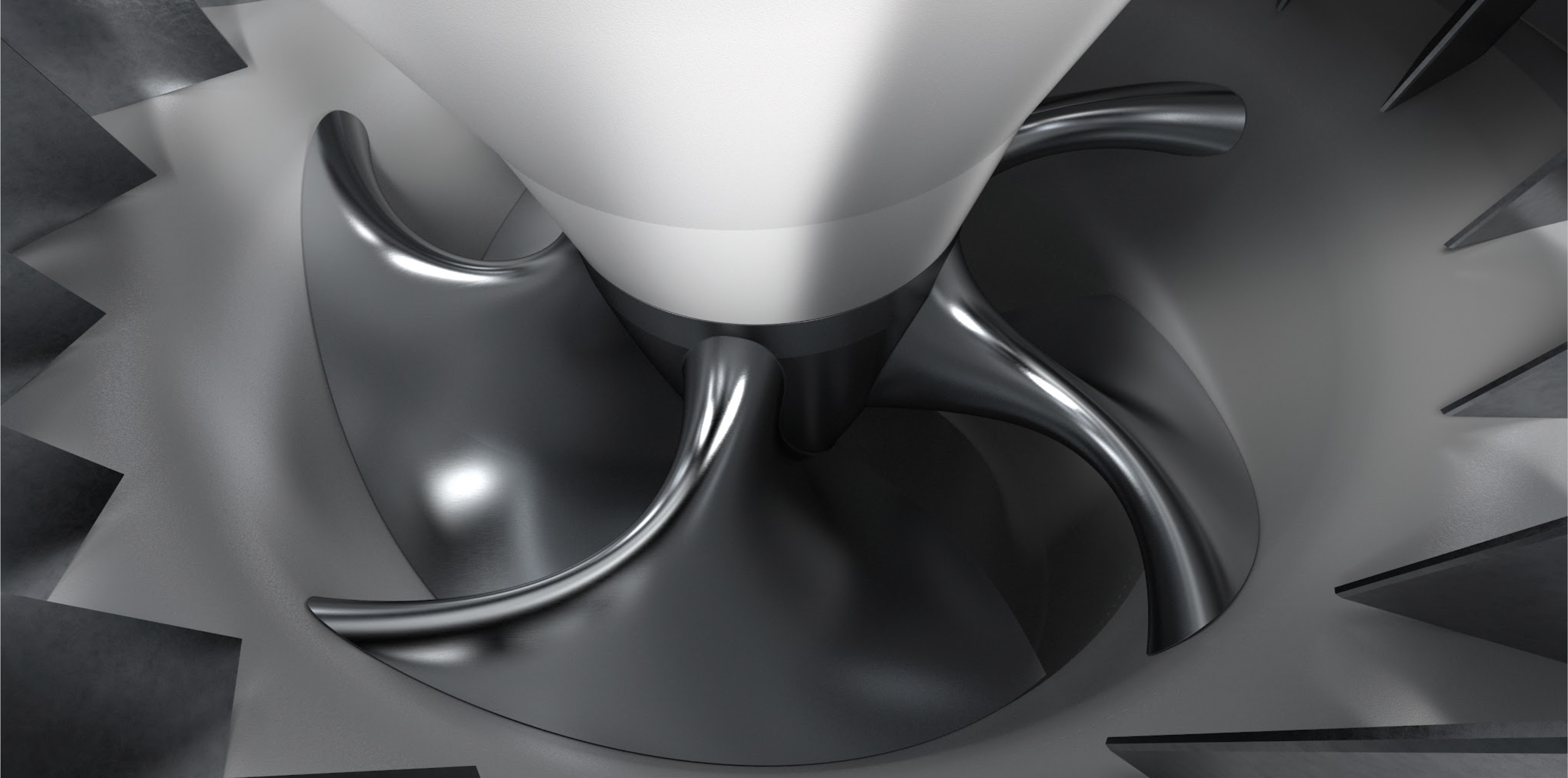
FishSafe™ Designs Match Existing Performance at St. Lawrence-FDR
New Turbine Designs Could Raise American Eel Survival Above 98% Without Reducing Generating Capacity at St. Lawrence-FDR Power Project
A FEMRF-funded study conducted by Natel Energy in collaboration with the New York Power Authority identifies a potential engineering path to significantly improve downstream fish passage at one of North America's largest hydroelectric facilities, with no change in generating capacity.
MASSENA, NY / ALAMEDA, CA – September 29, 2026 – Every year, adult American eels migrating downstream to the Atlantic Ocean must pass the Moses-Saunders Power Dam on the St. Lawrence River. These eels make the journey once, returning to the ocean to spawn at the end of a decades-long life. Under most conditions, the turbines are their only route past the dam, and testing at the St. Lawrence-FDR Project in 1997 measured turbine passage mortality at 26.5% (Verreault & Dumont, 2003). American eels form a single population across their entire range, which spans eastern North and Central America, and eels from the St. Lawrence basin have been estimated to represent between a quarter and a half of the species' total reproductive capacity (COSEWIC, 2006). Improving downstream passage survival here has accordingly been a long-standing objective for fisheries managers, regulators, and hydropower operators in both the U.S. and Canada.
Simulation results from a design feasibility study, funded by the Fish Enhancement, Mitigation and Research Fund (FEMRF) and conducted by Natel Energy in collaboration with the New York Power Authority (NYPA), indicate that innovative turbine runner designs could raise turbine passage survival for American eel to above 98% across all simulated operating conditions at the St. Lawrence-FDR Power Project, a 940 megawatt (MW) facility that NYPA owns and operates on the U.S. side of the dam. Computational fluid dynamics (CFD) simulations of the new runner designs show that they may be able to maintain the hydraulic efficiency at levels comparable to the existing turbines—between 94% and 95%.
The results are significant in part because fish-friendly turbine technology was previously evaluated for the Moses-Saunders Dam in 2006 and ruled out at that time, due to the need for extensive reconstruction. The Natel designs presented in this study are engineered as in-place replacements for the existing runners, requiring no changes to the dam, powerhouse structure, or plant operations.
Study Findings
Natel developed preliminary FishSafe™ Restoration Hydropower Turbine (RHT) runner designs for both unit types at the St. Lawrence-FDR Project, using 3D CFD modeling. Key CFD-predicted results include:
- Hydraulic performance: Peak hydraulic efficiencies of 94.6% and 94.3% for the two unit types at 25 meters gross head, within the measurement uncertainty of the field-tested efficiency of the existing units. Projected annual energy production was within 0.5% of existing generation under matched conditions.
- Fish survival: Blade strike survival rates above 98% for American eel across all simulated operating conditions. High survival rates are also expected for other focal species identified by the FEMRF, including lake sturgeon, walleye, northern pike, and muskellunge.
- Mechanical feasibility: The analysis concluded that the proposed designs are likely manufacturable using conventional methods and compatible with existing plant infrastructure, without reconstruction of the powerhouse.
"This study demonstrates that FishSafe™ designs are able to match the high efficiency and power output of the existing modernized units while elevating American eel survival above 98% for American eel," said Abe Schneider, Co-founder and CTO of Natel Energy. “Fish-friendly turbine replacement had previously been considered infeasible at this project. We are grateful for the FEMRF's investment in this work and for NYPA's collaboration in making it possible."
How the Designs Work
The proposed FishSafe™ RHT designs mitigate blade strike mortality risk via specialized blade geometries with three key characteristics: a very thick leading edge (approximately 50 centimeters/20 inches thick), a progressively slanted leading edge shape culminating in a 35-degree forward slant at the blade tip where velocities are highest, and the elimination of converging pinch points that can trap and sever fish between moving and stationary components. The FishSafe™ RHT shapes are able to achieve high hydraulic efficiency and operate without cavitation despite their thick leading edges, due to highly optimized thickness distributions.
Natel has conducted multiple laboratory studies of eel passage through turbines with similar blade geometry at smaller scale (Watson, 2022). In those studies, survival rates for American eel ranged from 99.2% to 100%. The projected survival rates for the St. Lawrence-FDR designs (above 98%) are consistent with those experimental results.
The St. Lawrence-FDR Project and the American Eel
The St. Lawrence-FDR Power Project (FERC P-2000) consists of 16 turbine-generator units on the U.S. side of the Moses-Saunders Power Dam, which spans the St. Lawrence River at the U.S.-Canada border. Ontario Power Generation operates an additional 16 units on the Canadian side. The total generating capacity of all 32 turbines is almost 2,000 MW. Under typical conditions, nearly all of the river's flow passes through the turbines.
NYPA has taken steps to support American eel conservation at the Project, including the installation of an award-winning upstream passage eel ladder in 2006, which contributed to restoring access for juvenile eels to habitat in Lake Ontario. The FEMRF, established through the Project's relicensing settlement between NYPA and the U.S. Fish and Wildlife Service, supports ongoing research and mitigation to benefit fisheries in the Lake Ontario/St. Lawrence River Basin.
Study Scope
The feasibility study utilized CFD simulations to make predictions of hydraulic performance and fish passage survival. The analysis was performed using original plant construction drawings and data provided by NYPA. Physical scale model hydraulic testing, such as to the IEC 60193 standard, is the industry best practice for measurement of hydraulic performance. NYPA has not committed to further studies.
A non-confidential version of the report is available on Natel’s website at www.natelenergy.com/stlawrence-fdr
About Natel Energy
Natel Energy is a technology and engineering company that develops high-performance hydropower turbines designed for safe fish passage. Natel creates FishSafe™ turbine designs informed by original fish passage experimental research combined with computational fluid dynamics modeling and analysis. The company conducts design feasibility studies, performs fish passage and performance testing, and works with trusted turbine manufacturers to produce its turbine designs. Natel is headquartered in Alameda, California. Visit www.natelenergy.com for more information.
About the Fish Enhancement, Mitigation and Research Fund
The FEMRF was established through the relicensing settlement for the St. Lawrence-FDR Project between the New York Power Authority and the U.S. Fish and Wildlife Service. Its purpose is to benefit fisheries resources in the Lake Ontario/St. Lawrence River Basin and to support research on the American eel and other species that may be affected by the Project. The FEMRF is administered by the U.S. Fish and Wildlife Service.
About the New York Power Authority
The New York Power Authority is the largest state public power organization in the nation, operating 17 generating facilities and more than 1,550 circuit-miles of transmission lines. More than 80 percent of the electricity NYPA produces is clean renewable hydropower. NYPA finances its operations through the sale of bonds and revenues earned in large part through sales of electricity.
Media Contacts
Natel Energy: Kate Stirr, kate@natelenergy.com
FEMRF: https://www.fws.gov/project/fish-enhancement-mitigation-and-research-fund
NYPA: www.nypa.gov
Works Cited
COSEWIC. (2006). COSEWIC assessment and status report on the American eel Anguilla rostrata in Canada. https://www.sararegistry.gc.ca/virtual_sara/files/cosewic/sr_american_eel_e.pdf
Watson, S.M., Schneider, A.D., Santen, L., Deters, K. A., Mueller, R., Pflugrath, B., Stephenson, J., Deng, Z. D. (2022). Safe passage of American eels through a novel hydropower turbine. Transactions of the American Fisheries Society, 151, 711– 1. https://afspubs.onlinelibrary.wiley.com/doi/full/10.1002/tafs.10385
Verreault, G., & Dumont, P. (2003). An estimation of American eel escapement from the Upper St. Lawrence River and Lake Ontario in 1996 and 1997. American Fisheries Society Symposium, 33, 243-251.
###
More Stories
Pique Action releases a micro documentary about Natel Energy
A 4-minute film about Natel Energy and founders Gia Schneider and Abe Schneider, part of the NextNow digital series profiling solutions to climate change and the people behind those solutions.
Natel Energy Continues Growth Trajectory Bringing On Chief Financial Officer Kizzie Brown
Brown, a 25-year finance industry veteran with degrees from Howard University & Harvard Business School, brings a wealth of experience spanning corporate finance & investment banking.
Video: Rethinking Hydropower, the Natel Energy journey, Gia Schneider
Gia talks with Tough Tech Summit from The Engine.


